

If you tried to start a gold fund SIP this morning, your application probably bounced.
From the 3 pm cut-off on October 15, India’s biggest fund houses stopped taking fresh money into their gold funds. No new SIPs, no lump sums, no top-ups. It landed days before Dhanteras, the one week a year when Indians buy gold almost by reflex.
Here is the chain, from regulator to your SIP to the import bill.
The chain of command
It started with SEBI. Shriram Mutual Fund told investors the restrictions followed SEBI instructions passed on through AMFI, the industry body. Reuters, citing people familiar with the talks, described it as a nudge from the regulator. SEBI has not commented publicly.
Then the notices went out, and the list kept growing. By Friday morning, 17 fund houses had curbed 20 schemes: gold ETF fund-of-funds and the older “gold fund” schemes that work the same way.
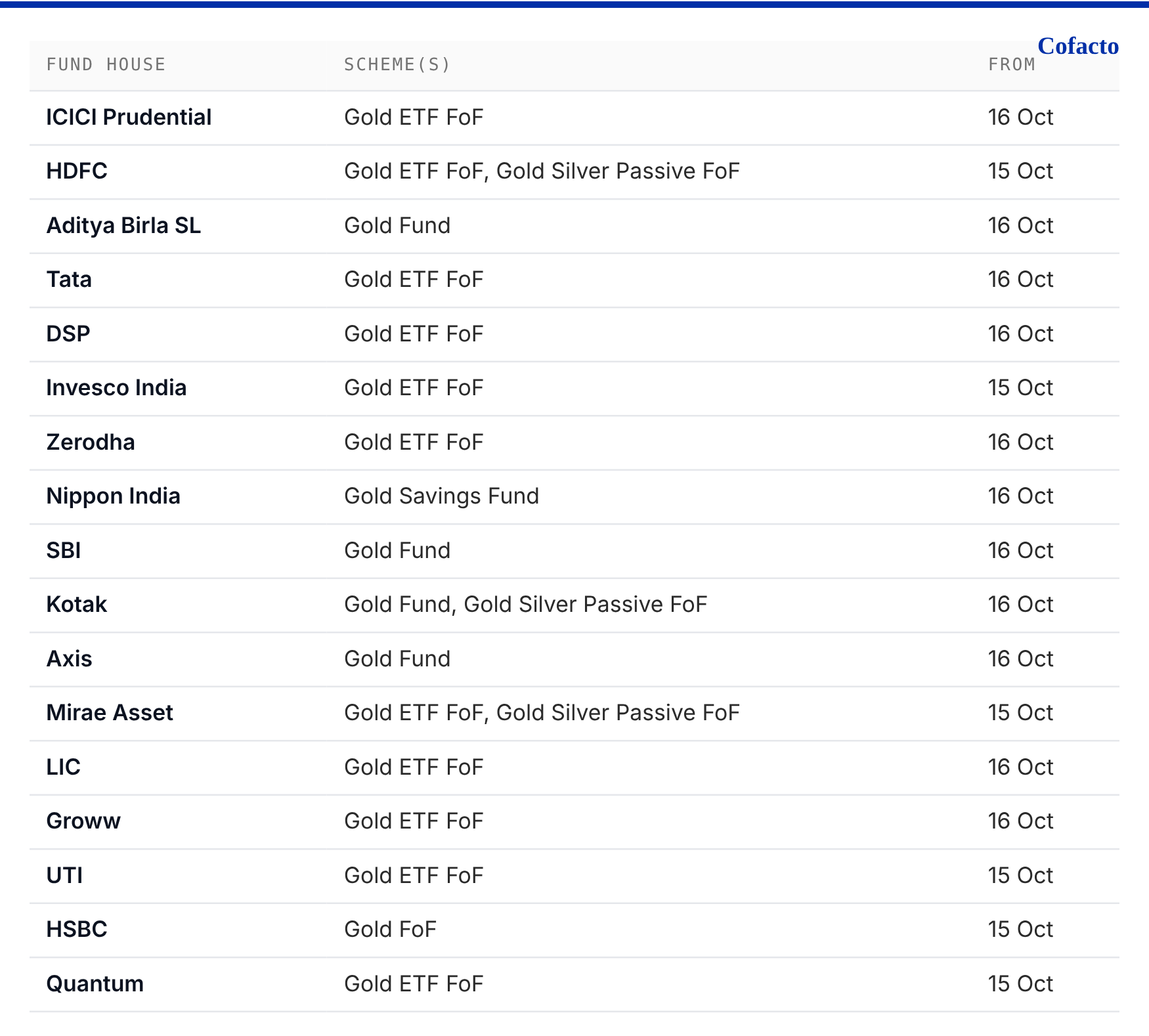
The terms are near-identical everywhere. Lump sums, switch-ins, new SIP and STP registrations and SIP step-ups are blocked. SIPs registered before the cut-off keep running. Redemptions are untouched. Every notice says “until further notice”.
Separately, Kotak, UTI and HDFC suspended bulk subscriptions to their gold ETFs, the route large investors use to have fresh units created directly by the fund house.
Is this gold only? Mostly. Every scheme on the list is a gold fund. Silver is affected only where a scheme holds both metals: the Gold Silver Passive FoFs of HDFC, Kotak and Mirae Asset. Business Standard also reports a few houses curbing silver FoFs. Standalone silver ETFs are open. The silver section below explains why the regulator could afford to go lighter there.
How a fund notice becomes an import control
Every gold ETF unit in India is backed by real metal. SEBI requires at least 95% of a gold ETF’s money in gold and gold-related instruments, which in practice means 995-purity bars in a custodian’s vault.
New money means new gold. When an FoF puts in fresh cash, the fund house creates new ETF units and buys bars to back them. India mines almost no gold, so those bars are imported.
Buying on the exchange is different. When you buy a gold ETF on your broker app, you buy units someone else is selling. No new units, no new metal, no new imports.
So the regulator left the market open and shut the pipe that pulls in fresh metal. FoFs sit right on that pipe, because every SIP rupee turns into fresh ETF creation. They are also the default route for investors who buy through distributors and don’t hold a demat account.
For scale: gold ETFs took in ₹4,450.61 crore in September 2026. At around ₹15,400 a gram, that is roughly 2.9 tonnes of gold someone had to buy.
How big is the ETF slice?
Small, but the fastest-growing part of the market.
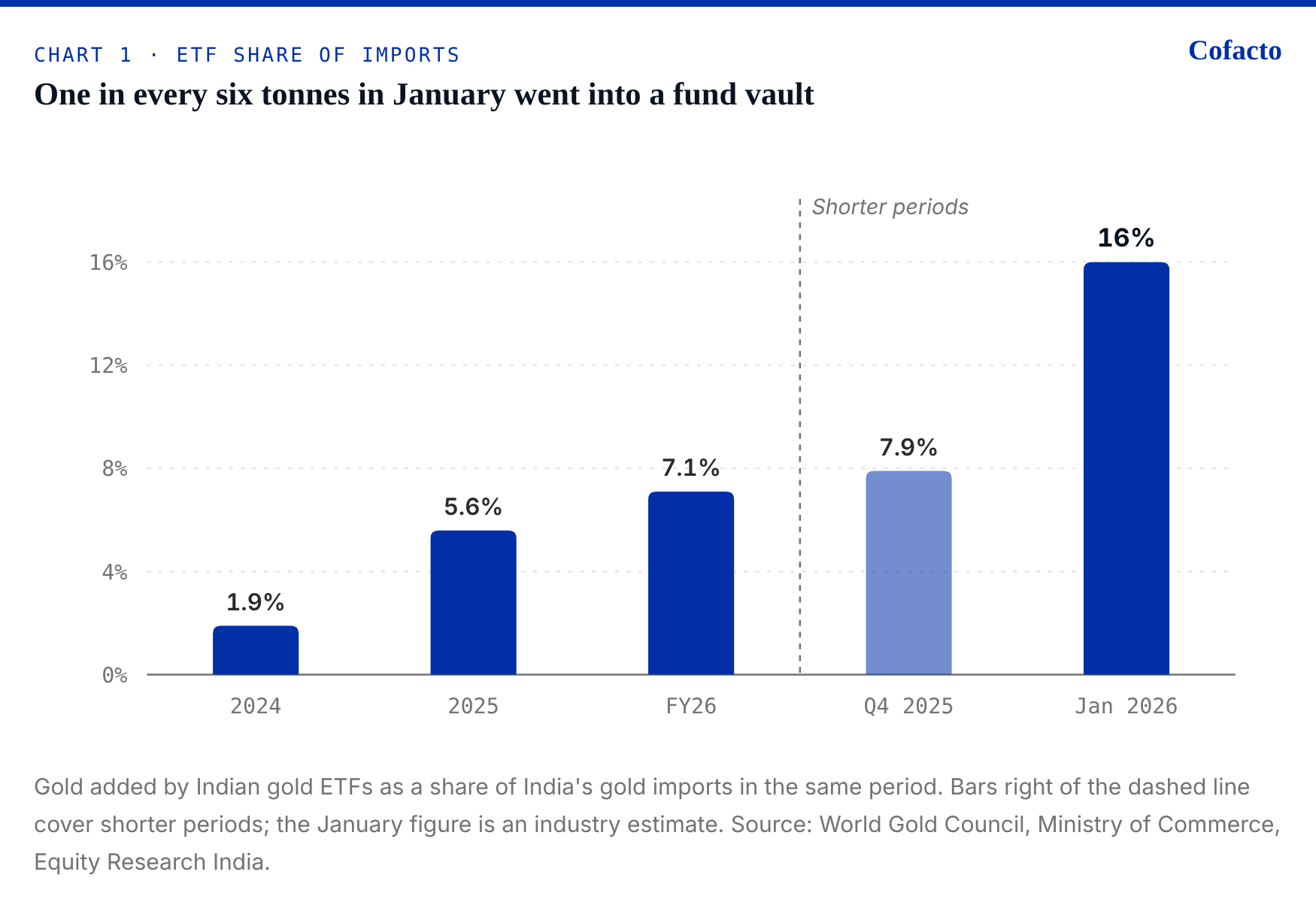
Gold ETFs were a rounding error in India’s import bill in 2024, at under 2%. By FY26 they took about 7% of all gold landing in the country. In the last festive quarter the share touched 8%, and in January 2026 roughly one in six imported tonnes went into a fund vault. That acceleration, more than the level, is what put ETFs on the regulator’s radar.
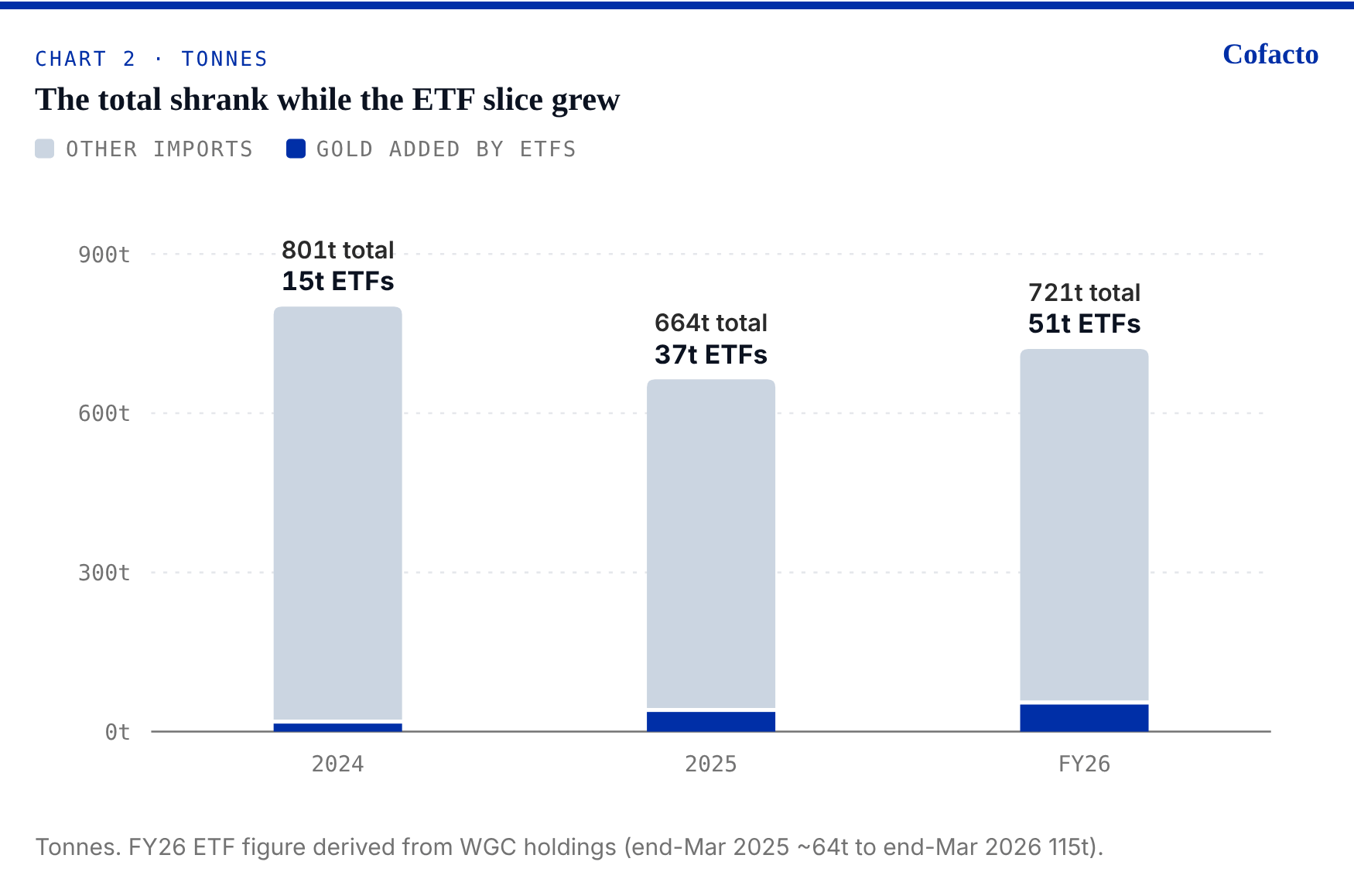
Total imports fell from 801 tonnes in 2024 to 721 tonnes in FY26 as record prices cut jewellery buying. Over the same stretch, gold bought by ETFs more than tripled, from 15 to 51 tonnes. The blue slice is still small in absolute terms, but it is the only part of demand growing this fast, and it is the easiest part for a regulator to switch off.
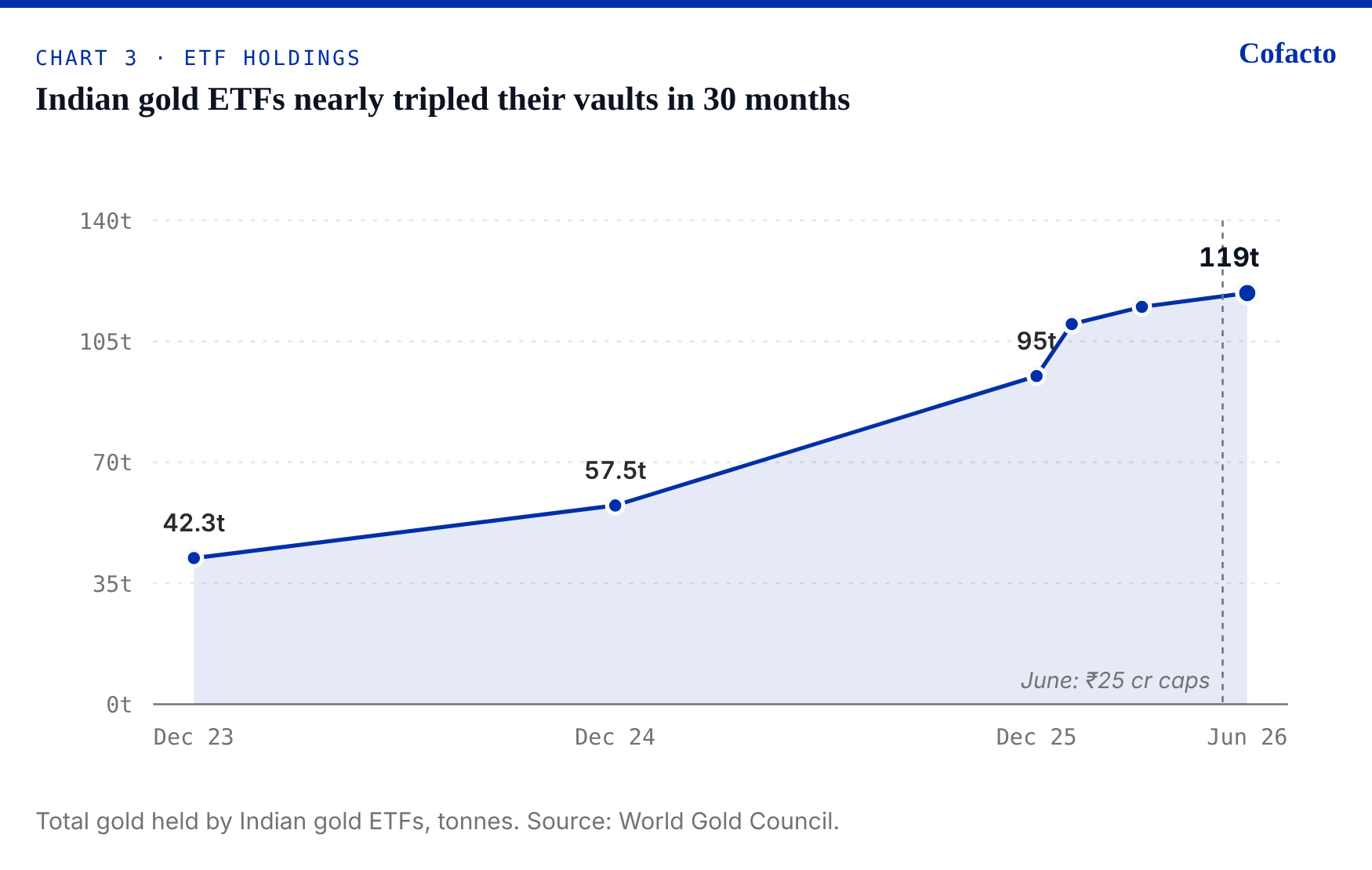
Indian gold ETFs held 42 tonnes at the end of 2023. By June 2026 they held 119 tonnes, almost three times as much. The steepest climb came between December 2025 and January 2026, when a record 15.5 tonnes went in during a single month. The June caps on ₹25 crore-plus tickets slowed the pace but did not stop it, which explains why October’s curbs go much wider.
Why the rupee is the real story
Gold is priced in dollars, so every tonne India imports is a dollar bill going out. That matters more when the rupee is already weak, and it has been for two years.
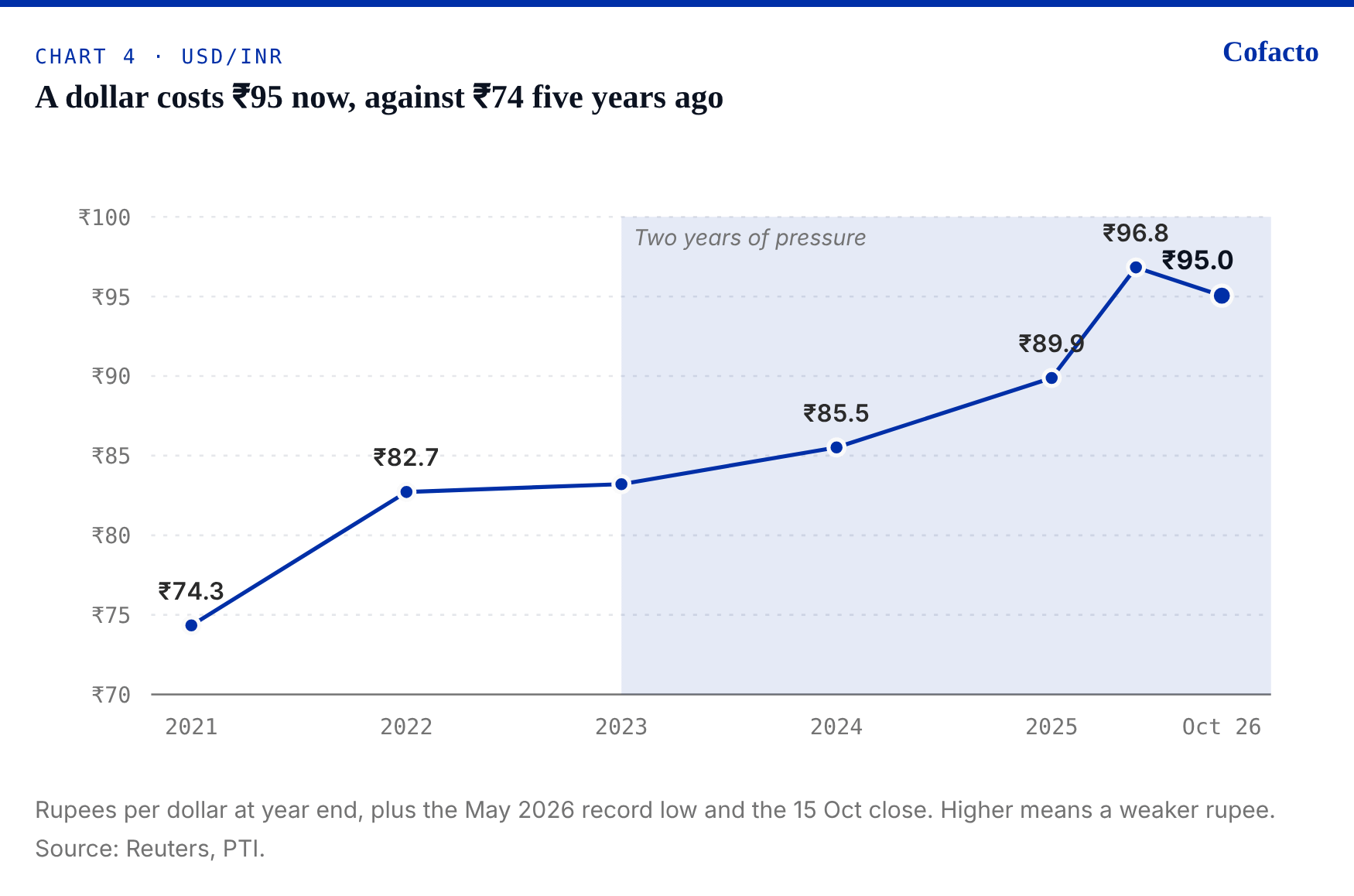
A dollar cost ₹83 at the end of 2023. Since then the rupee has weakened every year, falling about 10% in FY26 alone, its worst year in 14 years, and hitting a record low of ₹96.82 in May 2026 as crude spiked on the West Asia conflict. It has been Asia’s worst-performing major currency in both 2025 and 2026. Every tonne of imported gold has to be paid for in dollars, so a weaker rupee makes gold imports more expensive and adds to the pressure on the currency. This is the backdrop the curbs are responding to.
A weak rupee also makes gold dearer at home, which pulls in more investment money, which needs more imported gold. The curb is an attempt to break that loop before the festive peak.
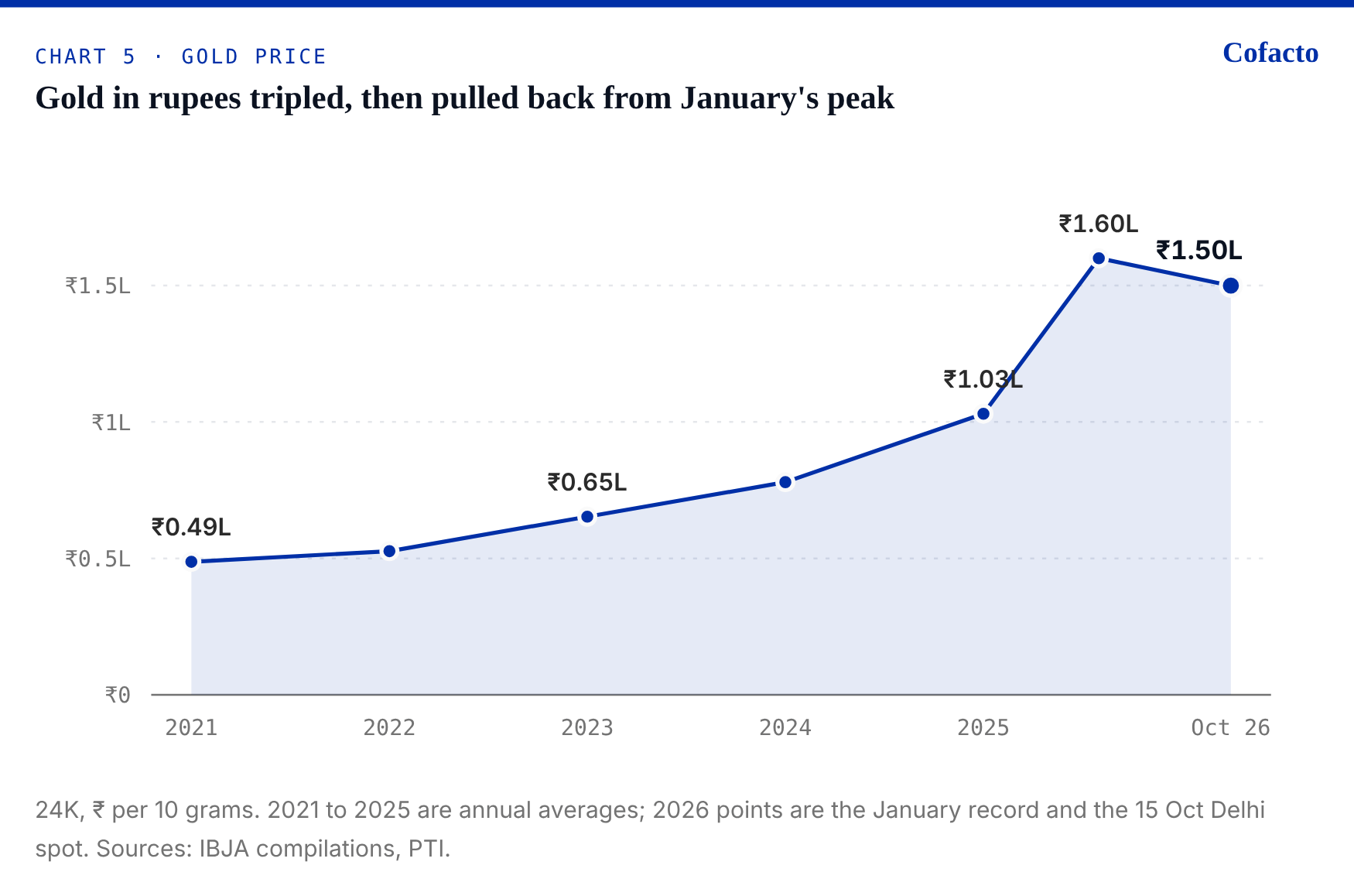
Gold in rupees has roughly tripled since 2021, from about ₹49,000 to ₹1.5 lakh per 10 grams. Part of that is the global rally and part is the weaker rupee, which raises the local price even when the dollar price stands still. Rising prices pulled investment money into gold funds, which in turn needed more imported metal. Prices have eased from January’s record, but remain far above where the ETF boom began.
What could the curbs save?
Treat this as an estimate.
Last year’s festive quarter, October to December 2025, saw Indian gold ETFs add about 17 tonnes, roughly 8% of the 215 tonnes imported that quarter. December set an all-time monthly inflow record.
If the curbs blunt a similar surge, 10 to 20 tonnes is a plausible ceiling. Every 10 tonnes kept out is worth about ₹15,000 crore, roughly $1.6 billion at today’s prices. For comparison, India’s whole gold import bill in September was $1.8 billion.
The real saving will be smaller, because of three leaks:
Exchange buying continues. Some FoF money will move to gold ETFs on the exchange. That creates no new gold, but it can push ETF prices above their fair value.
Coins, bars and digital gold. Money that moves there still needs imported metal.
Existing SIPs keep flowing. Only new money is blocked.
The fair reading: a sharp, targeted lever on the fastest-growing slice of demand, with a modest dent in the total import bill.
Where silver fits
Silver ETFs pull in imported metal the same way gold ETFs do, and proportionally they pull in far more. But silver had already been dealt with. In mid-May 2026 the government restricted silver imports in almost all forms, and from early June even silver grain and powder needed prior authorisation. Duty on both metals had been raised from 6% to 15%. Silver imports in May collapsed 94% from a year earlier to just 33 tonnes.
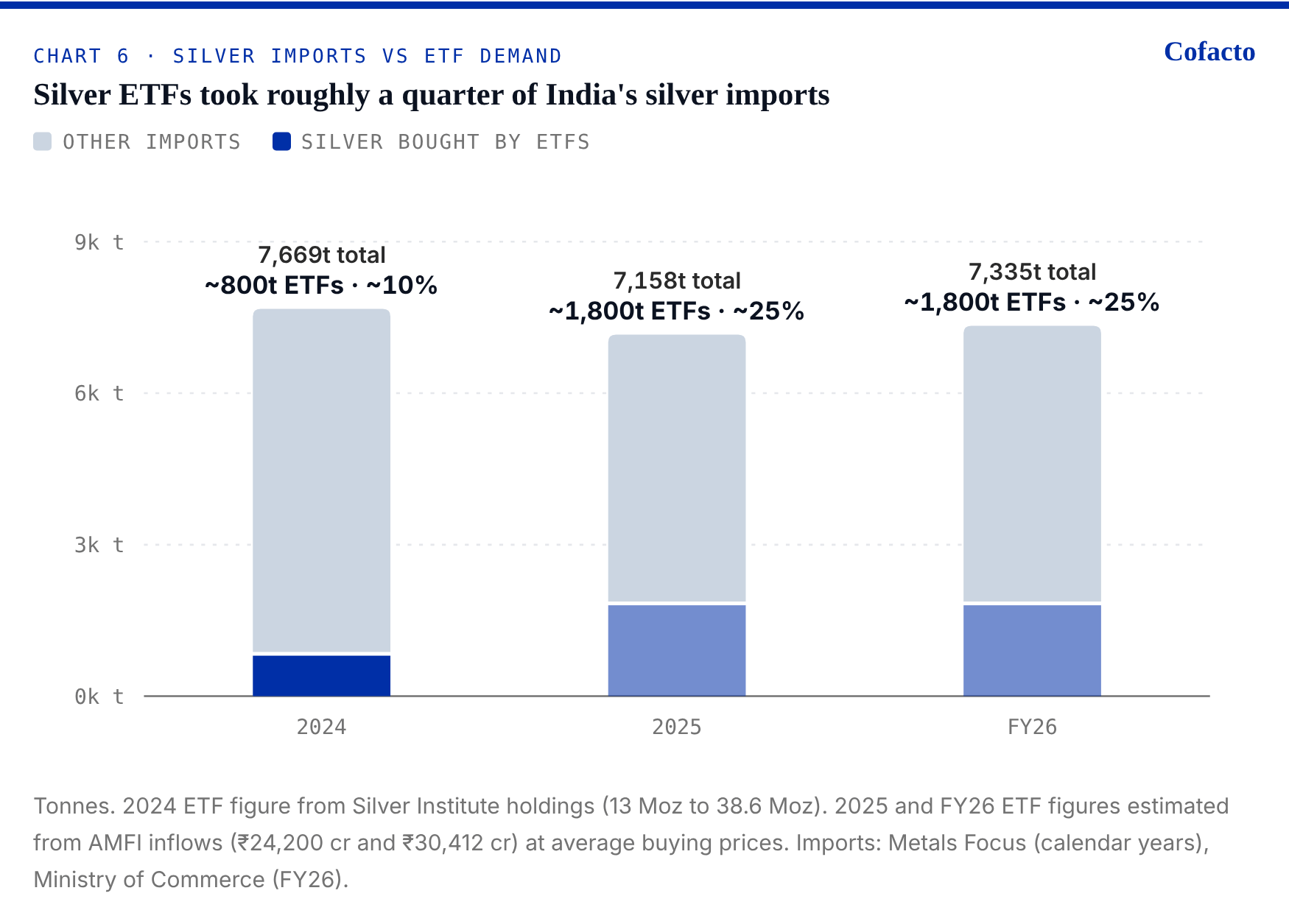
India imports far more silver than gold by weight, over 7,000 tonnes a year, mostly for industry and jewellery. Silver ETFs went from around 800 tonnes of buying in 2024 to an estimated 1,800 tonnes in 2025, as ₹24,200 crore poured in. FY26 tells the same story: about 1,800 tonnes bought from ₹30,412 crore of inflows, against 7,335 tonnes imported, a record that year. That is close to a quarter of all imports, three to four times gold’s ETF share. The lighter bars are estimates, converted from rupee inflows at average buying prices.
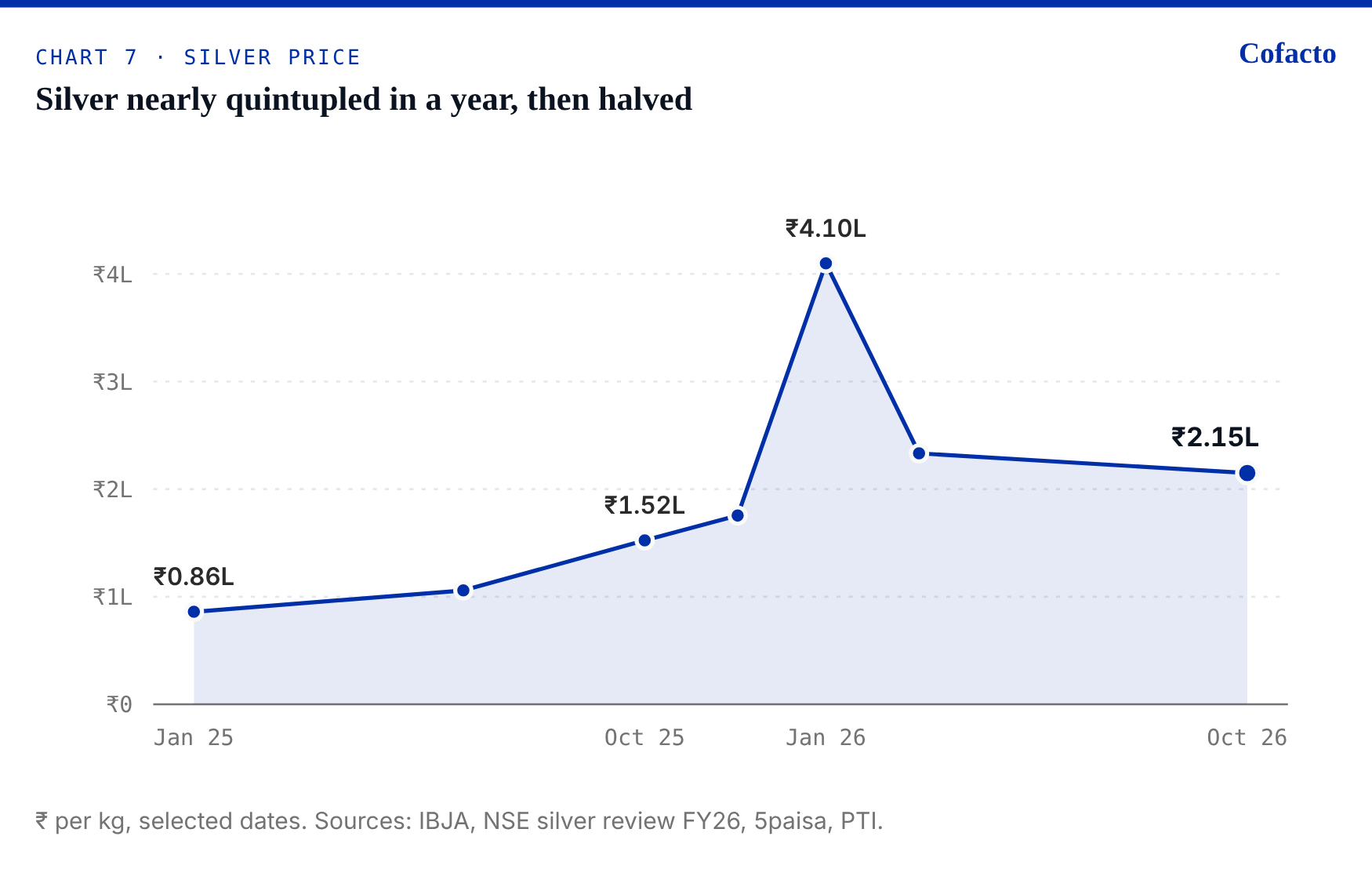
Silver started 2025 near ₹86,000 a kg and hit about ₹4.1 lakh on 29 January 2026. Silver funds have been paused before: in October 2025 a physical shortage pushed silver ETFs to 5 to 10% premiums over iNAV and fund houses shut their silver FoFs for a few weeks. Since the January peak, silver has lost nearly half its value and imports are tightly controlled. With the import tap already shut at the border, there was less reason to shut the fund tap as well.
What this means for you
You already have a gold fund SIP. Nothing changes. It keeps running, and you can redeem anytime.
You wanted to start one. You can’t, at any of the fund houses, for now.
You have a demat account. You can still buy gold ETFs on the exchange. Check the price against the iNAV first. When fund houses can’t create units freely, extra demand pushes the ETF price above the value of the gold inside.
We have seen this before. In October 2025, when physical silver ran short, Nippon India’s silver ETF traded 5.5% above its iNAV and some rivals hit 10%. Pay a 5% premium and the metal must rise 5% before you break even.
We’ve watched this movie before
This is the second turn of the tap this year. In June 2026, six fund houses stopped direct gold ETF subscriptions above ₹25 crore. October widens that from big tickets to all fresh money in gold funds.
The government had already raised customs duty on gold and silver to 15% this year, restricted silver imports outright in May, and the Prime Minister appealed to people to buy less gold. Imports in April to June 2026 fell 23% from a year earlier to 98 tonnes.
The pattern goes back further. In 2011, gold and silver made up 12.7% of India’s imports, and the government answered with higher duties and restrictions. In 2013, amid another round of duty hikes to shrink the current account deficit, fund houses worried about sourcing gold at all.
The reality check
The cost falls on India’s slow shift from gold in lockers to gold on paper. ETFs capture about 12% of India’s gold investment demand, against 25% in China. Every time the paper route gets harder, some demand drifts back to coins and jewellery, which still need imports and are far harder to track.
Three things to watch:
October import data, to see if festive demand simply moved into physical gold
Gold ETF premiums to iNAV on the exchange
How long “until further notice” lasts
Disclaimer : This is for educational purpose only. Not an investment advise.
Sources: fund house addenda (HDFC, DSP, Shriram and others, 15 Oct 2026); CNBC TV18; Business Standard; Reuters via investingLive; World Gold Council; FY26 imports; 2025 demand; rupee record low; June curbs; silver premiums; January ETF share.
The best quantified take I've seen on this: about ₹15,000 crore (~$1.6B) per 10 tonnes kept out, against a $1.8B September import bill. Agree that ETF premiums to iNAV are the thing to watch next, since exchange-traded gold ETFs are still open. Thanks for noting the June bulk-subscription limit too, because that history matters.